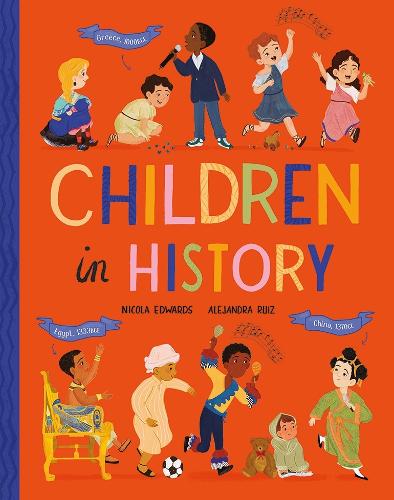
Children in History is an absolutely fascinating, inspiring, illustrated hardback book that explores what daily life was like for children in different historical periods and in different places such as at home, school, play, work and in the world.
The section on homes through history explores types of homes, food, health and hygiene, sleep and bedtime and pets and animal helpers. I was absolutely fascinated by the hidden, underground city of Derinkuyu in Turkey which was used for thousands of years until the 1920s. I have no doubt that children will be fascinated by the many facts shared in this section: Did you know that European colonisers in North America used corn cobs (with the corn stripped off) to wipe their bums? Or that Queen Elizabeth’s childhood pet was a chameleon?
The section on children at school explores reading and writing, life in the classroom and languages. I loved the two-page spread on children of Nicaragua who developed the sign language ISN which is now an internationally recognised sign language. Children will enjoy being challenged to write their name in the hieroglyphic alphabet and their birthday using Maya numbers.
Children at play shares sections on toys through the ages, family entertainment, sports and games, celebrations and festivals including those that honour the dead or darkness. There is a wealth of information which I have no doubt will fascinate children and will encourage them to compare their lives with those of children throughout history. I think they’ll be particularly drawn to the section on lighting up the dark side of life where they will learn about some dark traditions such as the French-Canadian bogeyman who was said to steal children who refused to go to bed on time.
There is a shorter section on children at work which shares some of the jobs young children undertook from becoming warriors to working as chimney sweeps.
The final section, children in the world, shares some incredible information about children on the move, children as rulers, inspirational children and children growing up. I have no doubt that these will prove talking points for children, especially learning that children were posted to relatives via the postal service and discovering more about children such as Kim Ung-Yong who began working for NASA at eight and gymnast Nadia Comaneci who. at fourteen, won five Olympic medals.
This book is presented in an incredibly engaging and appealing way with short sections of information accompanied by gorgeous illustrations, often framed, which help young children understand the text. Each section is introduced with a series of images and a question or thinking point to encourage curiosity and individual thinking before finding out more in each section.

This is a wonderful book which will empower and inspire children as they learn about children in history across different parts of the world and is a book that will encourage them to think about their own history – and their future!
Thank you to Little Tiger for providing me with a copy in exchange for my honest opinion.

 Book Craic